
FUSION
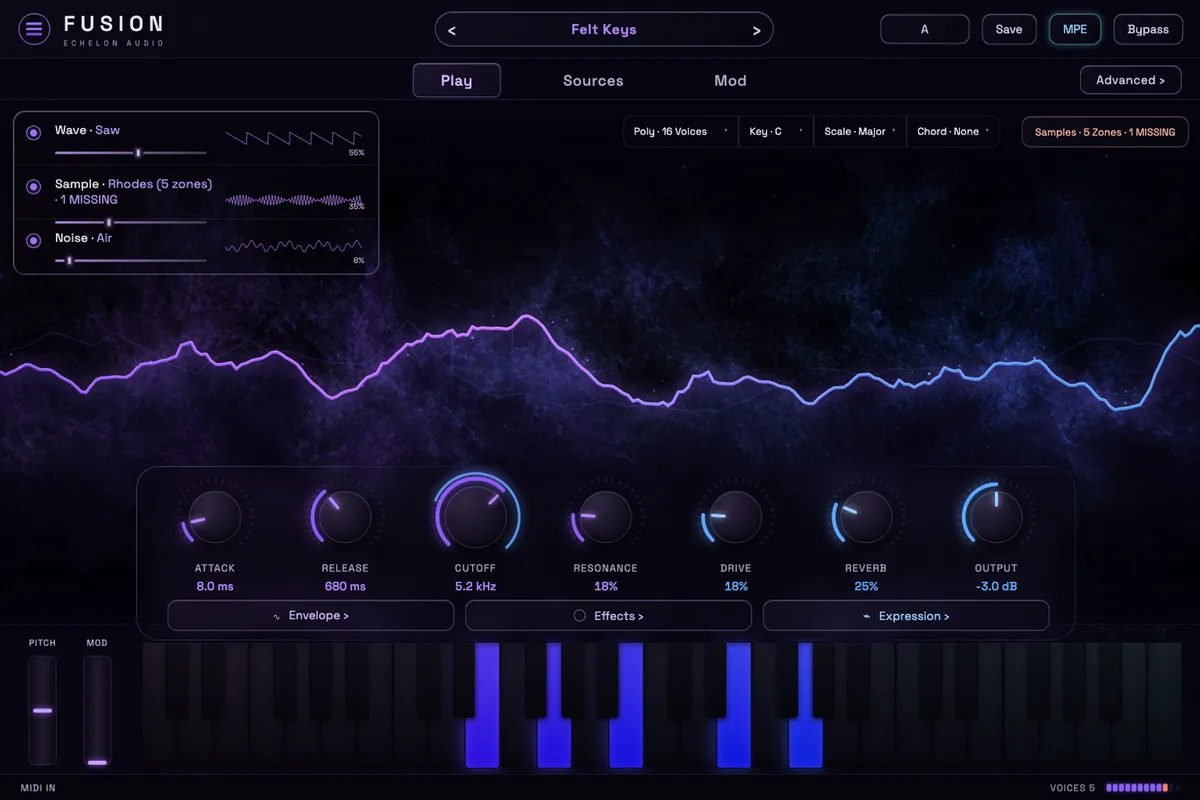
hybrid multi-engine workstationA hybrid multi-engine workstation synth combining sampling, synthesis and FX layers. One instrument for huge, modern sounds.

- Multi-engine hybrid synth
- Sample + synthesis + FX layers
- Huge modern sounds
- One instrument, endless tones
- Which patch made you want to write something? Name it. The preset that starts a song is worth more to us than any spec on the box.
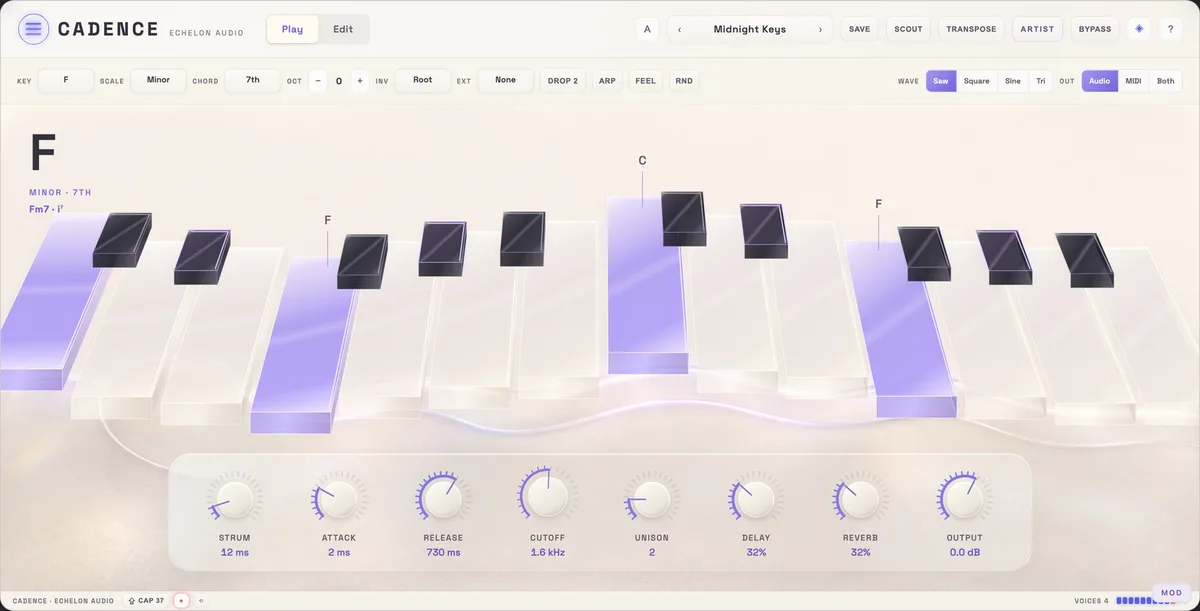
- Find the voice ceiling — hold big chords with long releases until it complains, and tell us the machine and buffer size. Fusion shares its engine with Cadence and Arp, so that number helps three plugins.
- Sustain pedal and pitch bend from your own controller — does it feel like an instrument you'd perform on?
- Save a patch, reopen the session, confirm the exact sound comes back.
Learn FUSION
QUICK-START · 8 MINBuild a huge hybrid patch from three layers, lock it to a key, and thicken it into a modern lead or pad.
- 01
Balance the three layers
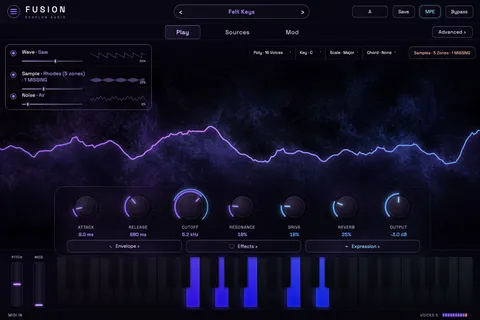
On the Edit tab, set the WAVE, SAMPLE and NOISE knobs — WAVE is the wavetable harmonic core, SAMPLE adds an acoustic attack transient, NOISE adds air and texture on top. The blend of those three is the patch's identity.
- 02
Lock KEY / SCALE / CHORD
In the top bar, set KEY and SCALE, then pick a CHORD type for one-finger stacks — or leave CHORD on None and play it straight. Add STRUM to stagger chord tones like a strummed guitar.
- 03
Shape the envelope and filter
Set ATTACK / DECAY / SUSTAIN / RELEASE for the amp contour — instant attack for plucks, long for pads. CUTOFF is the master brightness; add RES for squelch. VEL CUT makes harder playing open the filter for a patch that responds to touch.
- 04
Thicken with unison
In the Voice module, raise UNISON (up to 7 copies), spread them with DETUNE (subtle chorus to wide supersaw) and pan them with SPREAD. ANALOG adds per-voice vintage pitch drift like aging hardware.
- 05
Add space
The cyan macro group is the send section: DRIVE for anti-aliased saturation, DELAY and REVERB sends, CHORUS for width, OUTPUT for level. SYNC locks delay time and LFO rates to the host tempo.
- 06
Route modulation
On the Mod tab, drag a source chip (LFO 1/2, Env 2, Velocity, Mod Wheel…) onto any knob to create a route — the knob draws its modulation range as a second arc. The Filter Envelope's F AMOUNT goes negative for the acid-style reverse sweep.
- 07
Drop your own sample
Drop a WAV/AIFF on the sample layer — an 808, a vocal chop, a foley hit — and the SAMPLE knob plays YOUR one-shot, pitch-tracked from its detected root note.
- FUSION is always listening: drag the ⇪ CAP chip into your DAW to drop your recent playing as a MIDI clip — the take you just improvised is never lost.
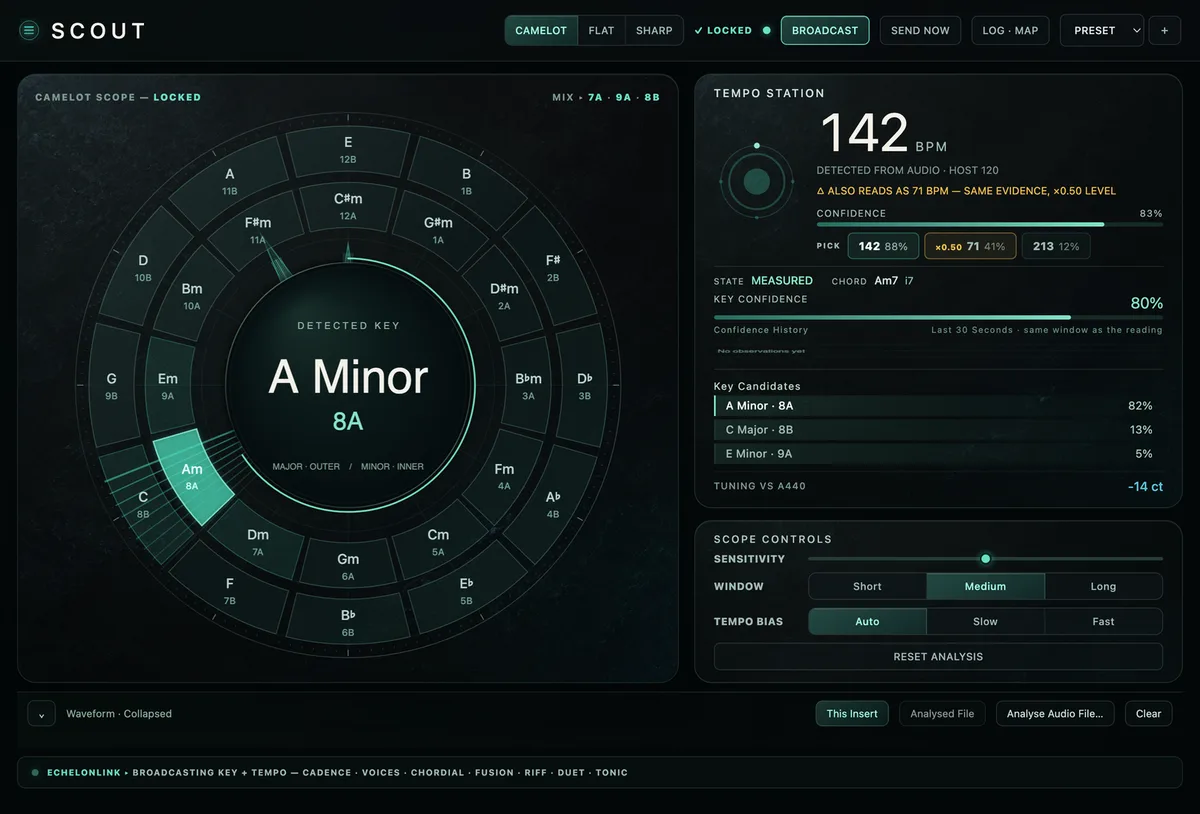
- The SCOUT button follows SCOUT's live key detection; TRANSPOSE makes a key change shift actual pitch instead of just re-mapping notes.
- Right-click any knob to type an exact value; double-click resets; shift-drag is fine adjustment.
- The ◈ button toggles the background visuals — turn them off to save CPU on big sessions.
Every control, its range, and what it actually does — the complete FUSION manual.
Download manual (PDF)All manualsActivation
iLok (PACE) — machine, iLok Cloud or iLok USBLicense lands on your iLok
Accepted testers get every Wave-1 plugin deposited to their iLok account — machine activation, iLok Cloud or iLok USB, your call.
Open the plugin
Insert FUSION in your DAW (AU · VST3 · AAX). First launch asks for activation via iLok License Manager.
You're in until August 30, 2026
Beta licenses run through the round. Your license codes and downloads live in the tester portal.
Not in the round yet? Applications are open — we accept in waves.
Apply for the closed beta