

 SCOUT · v1.2.2 · VST3 · AU · AAX
Utility · one of the 34
SCOUT
Know the key before you play a note.
Real-time key and BPM detection that broadcasts to every Echelon instrument in the session.
Own it
$69perpetual · free updates
Trial covers all 34 units, then $17.99/mo. Buy Now goes straight to checkout.
macOS (Universal) + Windows · iLok · New plugins drop Sept 18
Not today? so it’s easy to find again.
Hear it · one instance · level-matched
Program
Jazz / hip-hop sample — level-matched, one instance
Spectrum · SCOUT detected
Processing
Key and BPM detected live · Readout: the player overlays what SCOUT found · Sample flipping starts here
Detection
Key + BPM
Measured on this demo · method
Δ loudness0.0 dBΔ crest0.0 dBΔ top end0.0 dBTrue peak-1.0 dB
Why it exists
You got sent a loop pack with no key labels, a reference with no BPM, and a vocal in who-knows-what. Twenty minutes of noodling later you're still not sure.
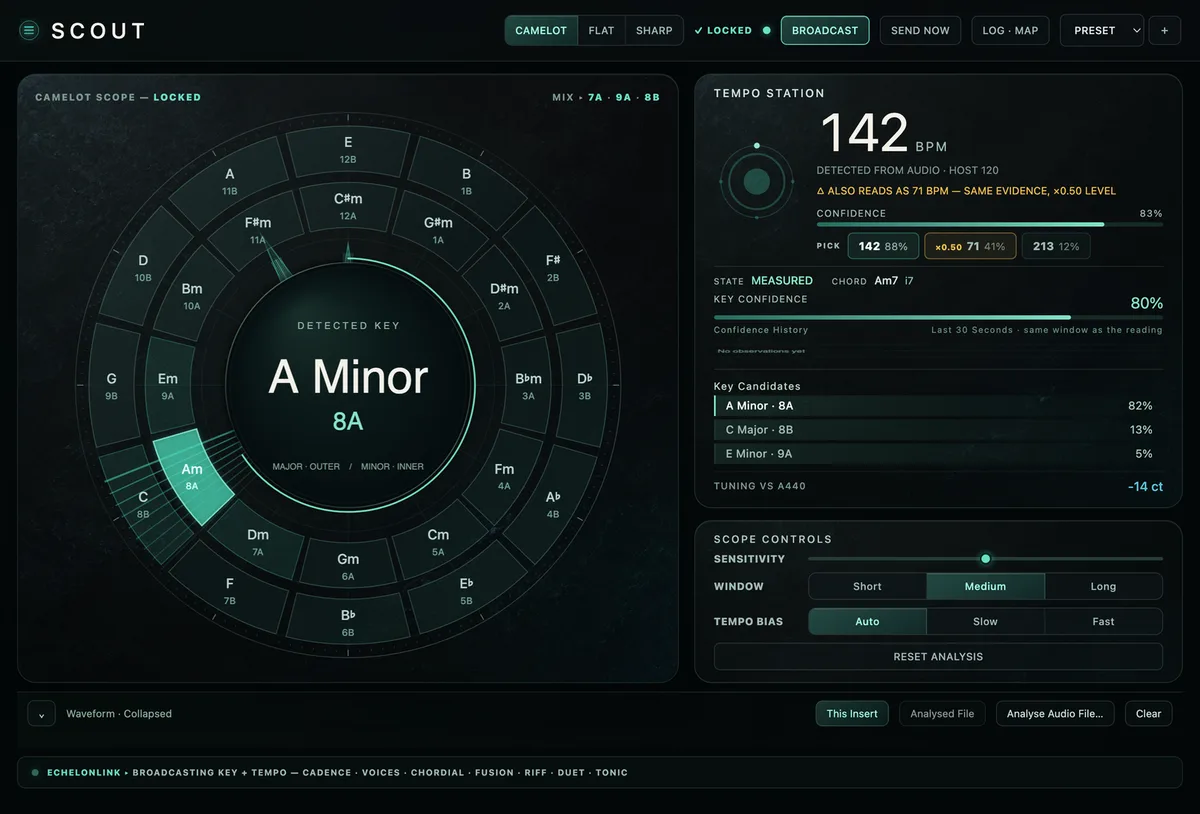
SCOUT reads key and tempo in real time and broadcasts them to CADENCE, ROOT and VOICES over EchelonLink — set it once and the whole session plays in key by itself.
In the session
- Read key and BPM off any loop in seconds.
- Broadcast the key to CADENCE, ROOT and VOICES automatically.
- See half-time and triplet readings and pick the one you want.
- Run it as a zero-latency analysis tap.
Under the hood
Real-time key detection✓
Accurate BPM tracking✓
EchelonLink broadcast to the fleet✓
Zero-latency analysis tap✓
System requirements
Versionv1.2.2
FormatsVST3 · AU · AAX
macOSmacOS 11+ · Apple Silicon + Intel (Universal)
WindowsWindows 10/11 · 64-bit · VST3 + AAX
LicensingiLok · machine, cloud or USB
DeliveryEchelon Audio Hub