
Echelon AudioEchelon Audio
← The eighteenUNIT 09 / 18SaturationAU · VST3 · AAX

KNOCK

808 harmonic-knock saturator

An 808 harmonic-knock saturator with parallel triode/pentode drive and a clean sub-lock crossover. Make 808s and bass cut on any system while keeping the low end solid.

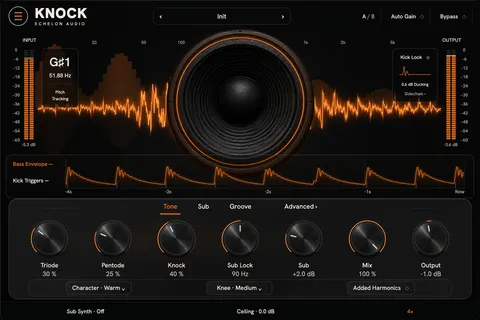
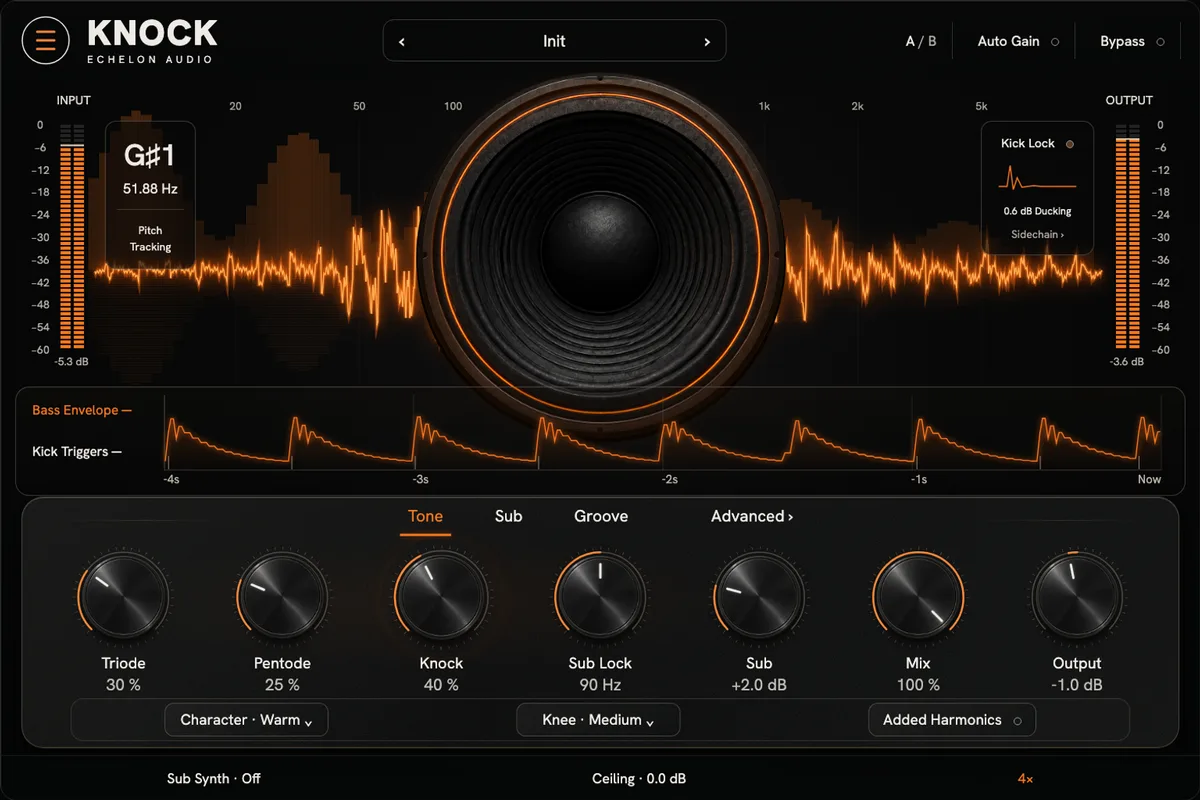
KNOCK interface
KNOCK — plugin interface · Closed Beta — Round 1
What's in it
  • Parallel triode (even) + pentode (odd) drive
  • Sub-Lock keeps the fundamental clean
  • Pitch-locked Sub-Synth + attack Click
  • 808s that knock anywhere
What we'd love your ears on
  1. Check it on a phone or laptop speaker, then in the car. That's the whole job — the 808 has to read on a speaker with no low end and still feel solid on a system that has one. Tell us how it does on both.
  2. Sub-Synth on a gliding 808. Pitch-tracking through a slide is the trick we're most proud of here — let us know if it holds.
  3. Take the drive all the way up. We'd love a second opinion on how the harmonic density feels up there — richer, or busier than you'd want?
  4. Click on a soft 808 — does it give you usable attack?

Learn KNOCK

QUICK-START · 6 MIN

Make an 808 read on a phone speaker while the sub stays clean and tight underneath.

  1. 01

    Set the SUB LOCK

    Set the SUB LOCK crossover (40–160 Hz) just above the 808's fundamental — everything below it stays clean and out of the saturation. This is the reason KNOCK doesn't turn your sub to mud.

  2. 02

    Drive it

    Push INPUT into the saturator and turn on AUTO GAIN so you judge tone, not level. Blend TRIODE for even-harmonic warmth and roundness against PENTODE for odd-harmonic edge and bite.

  3. 03

    Turn up KNOCK

    KNOCK is the signature control — it emphasises the punchy attack and midrange so the 808 stays audible on small speakers and phones. Dial it while monitoring on something small; that's the target device.

  4. 04

    Reinforce the sub

    On the SUB tab, raise SUB SYNTH to regenerate a clean pitch-locked sine at the tracked fundamental — it rebuilds a weak 808's sub and holds through glides. Set MONO to collapse everything below ~120 Hz for a centred low end.

  5. 05

    Add attack

    On the BASS tab, raise CLICK for a defined point of impact, TUNE it to sit with the beat (lower = thud, higher = tick), and set DECAY short for a tick or longer for a pluck.

  6. 06

    Finish the output

    Use MIX for parallel blending if the full-wet version is too much, set the CEILING a dB or two down as a safety clip, and match OUTPUT against bypass.

Worth knowing
  • FOCUS tilts just the saturated harmonics darker or brighter without touching the clean locked sub — use it instead of EQ after the fact.
  • Character voicings: Smooth for melodic 808s, Aggressive for distorted bounce; KNEE Hard snaps into clipping for a harder break-up.
  • DELTA solos only what KNOCK is adding — a fast way to hear whether you're adding knock or just fizz.
  • Check the result on a phone speaker AND a system with sub. The phone tells you if KNOCK worked; the sub tells you if SUB LOCK did.
Full control reference

Every control, its range, and what it actually does — the complete KNOCK manual.

Download manual (PDF)All manuals

Activation

iLok (PACE) — machine, iLok Cloud or iLok USB
01

License lands on your iLok

Accepted testers get every Wave-1 plugin deposited to their iLok account — machine activation, iLok Cloud or iLok USB, your call.

02

Open the plugin

Insert KNOCK in your DAW (AU · VST3 · AAX). First launch asks for activation via iLok License Manager.

03

You're in until August 30, 2026

Beta licenses run through the round. Your license codes and downloads live in the tester portal.

Universal macOS builds — Apple Silicon + Intel

Not in the round yet? Applications are open — we accept in waves.

Apply for the closed beta