

Echelon AudioEchelon Audio
← The eighteenUNIT 02 / 18VocalAU · VST3 · AAX

VOICES

scale-aware harmony engine

Turn one voice into a section. VOICES listens to your key and writes real harmony voicings — thirds, stacks, spreads — with humanized timing and pitch.

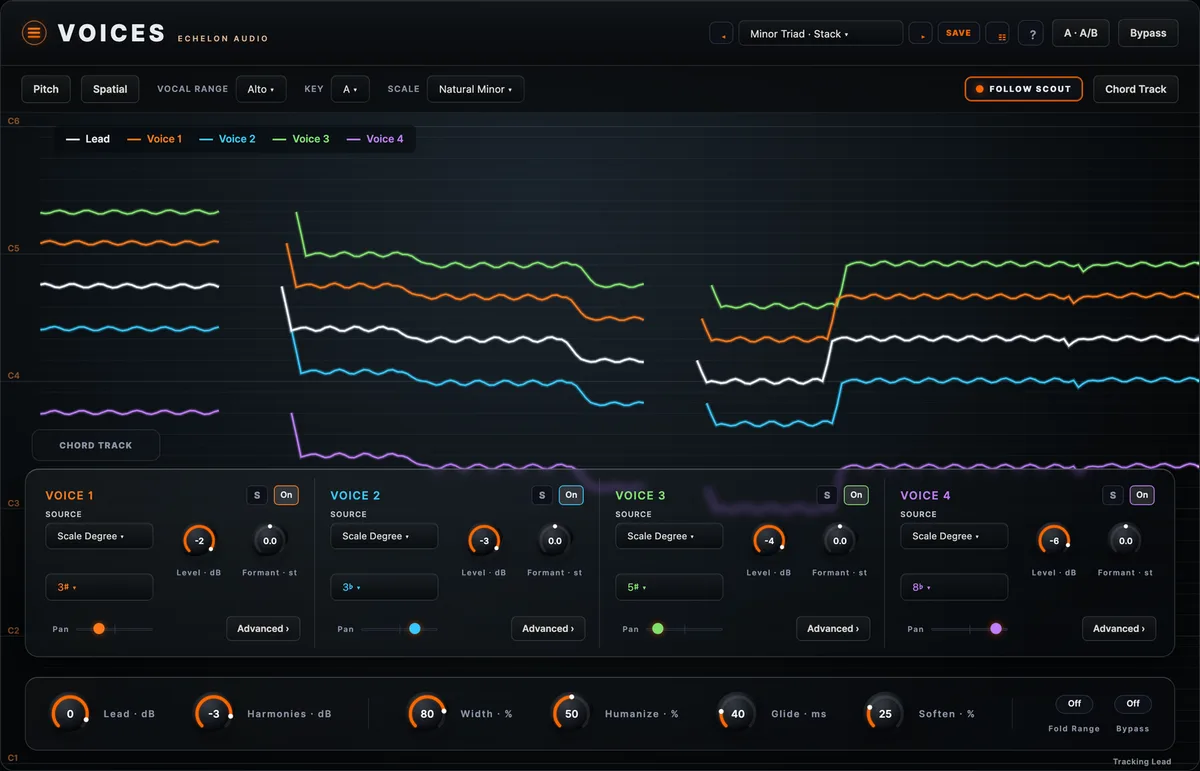
VOICES interface
VOICES — plugin interface · Closed Beta — Round 1
What's in it
  • Scale-aware harmony voicing
  • Up to 8 humanized voices
  • Spread, tightness & vibrato per voice
  • Key-locked — never a sour note
What we'd love your ears on
  1. See if you can find its limits. Set the key, then sing something chromatic or bend into a note. Staying musical through that is the whole promise — and if you ever do hear a sour voice, that's a brilliant catch (send the key and roughly what you sang).
  2. Stack 8 voices on an ad-lib. Does it read as a real section? That's the sound we were chasing.
  3. Push the range with very low and very high source notes — voices fold back into range, and we'd love to know whether that always sounds like a choice.
  4. Change key mid-session and tell us it keeps up.

Learn VOICES

QUICK-START · 6 MIN

Turn one lead vocal into a keyed, humanized harmony stack that reads as a real section.

  1. 01

    Set KEY and SCALE

    Pick the song's KEY and SCALE at the top — every harmony is generated against them, so this is the one setting that can't be wrong. If SCOUT is in the session, hit FOLLOW SCOUT and it sets both from the live detection.

  2. 02

    Pick a VOCAL RANGE

    Set VOCAL RANGE to your singer's register so voicings sit naturally. Leave FOLD TO RANGE off to start — on a low lead it fires constantly and inverts intervals, turning a 3rd down into a 6th above.

  3. 03

    Build the stack

    Enable voices and set each one's interval chip — the small number on the chip shows the interval it will ACTUALLY produce in the current key. Use each voice's LEVEL and FORMANT to seat it: shift formants down slightly on low voices, up on high ones, so they read as different singers.

  4. 04

    Balance LEAD vs HARMONIES

    HARMONIES is the master blend of the whole stack against the lead; LEAD is your original vocal's level. Drop LEAD to zero to audition the stack alone, then bring it back and tuck the harmonies under it.

  5. 05

    Humanize it

    Turn up HUMANIZE until the stack stops sounding like a robot — it adds per-voice pitch drift, onset smear and formant variation. Set GLIDE slower for singers settling into notes, faster for a tight synthy stack.

  6. 06

    Set the width

    WIDTH spreads the harmony stack around the centered lead. Zero keeps everything mono-safe; check your mono fold-down before pushing it wide.

Worth knowing
  • Presets are grouped BY KEY — pick one voiced for your song's key and you're 80% there.
  • Switch a voice to MIDI Note or MIDI Poly mode to play the harmony line yourself instead of using scale-degree intervals.
  • If a low lead makes harmonies jump above it, that's FOLD TO RANGE doing octave-folding — toggle it and compare.
Full control reference

Every control, its range, and what it actually does — the complete VOICES manual.

Download manual (PDF)All manuals

Activation

iLok (PACE) — machine, iLok Cloud or iLok USB
01

License lands on your iLok

Accepted testers get every Wave-1 plugin deposited to their iLok account — machine activation, iLok Cloud or iLok USB, your call.

02

Open the plugin

Insert VOICES in your DAW (AU · VST3 · AAX). First launch asks for activation via iLok License Manager.

03

You're in until August 30, 2026

Beta licenses run through the round. Your license codes and downloads live in the tester portal.

Universal macOS builds — Apple Silicon + Intel

Not in the round yet? Applications are open — we accept in waves.

Apply for the closed beta